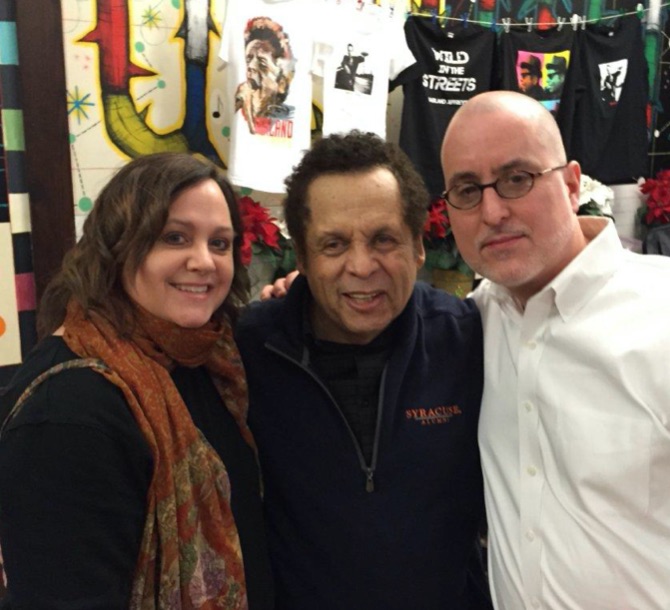
If you’ve looked at some of my recent posts, you might get the impression that this is a Bruce Springsteen fan page, but it’s not. Well, it kind of is, in that Bruce had a pretty big impact on me, I’ve seen him play live multiple times, and I play … let’s just say lots of Springsteen songs on the guitar.
I swear, though, I have musical interests other than Bruce, and I plan to write about them, too.
But since I’m on the topic, I thought I’d write about what I call the Springsteen-adjacent artists I’ve followed for years. There’s Little Steven, of course, whose Disciples of Soul records I bought when they came out in the ’80s. And Southside Johnny and the Asbury Jukes, who were one of the opening acts for the Rolling Stones when I saw them at Soldier Field in 1978. How can you not love a polyester-suit-clad nine-piece band with a horn section blasting their way through “The Fever” and “I Don’t Want to Go Home” at 11:30 a.m. in the blazing heat of a Saturday in July.
And then there’s Garland Jeffreys, perhaps less known than the others but no less influential, in my book. Garland got some early airplay with a song called “Wild in the Streets,” and then scored a pretty successful 1981 album, Escape Artist (featuring, as was the tradition at the time, members of the E Street Band). Escape Artist resulted in a few videos that showed up on MTV from time to time and featured “R.O.C.K.,” a song that Chicago radio legend Lin Brehmer (may he rest in peace) called “the greatest song ever written.” (Lin Brehmer had about a dozen songs he called “the greatest song ever written,” like “Gimme Shelter,” but “R.O.C.K.” was one of them.) In the 1990s, Garland’s Don’t Call Me Buckwheat had some modest success, thanks to the hip-hop inspired “Hail, Hail Rock ’n’ Roll” and at least one appearance on David Letterman.
I came to know Garland’s music through my late brother John, who also turned me on to Southside Johnny. John is also the reason I became a Clash fanatic, but more on that later.
Anyway, here’s where the story takes an unexpected twist. Not long after he released Don’t Call Me Buckwheat, Garland took a break from touring and recording, releasing only two new albums — Wildlife Dictionary and I’m Alive — over the next 15 years. And then, in 2011, he came roaring back with a fantastic album called The King of In Between, an apt description for an artist with Black and Puerto Rican roots who always straddled America’s racial divide.
Now 2011 was a different time in the social media world and Garland (or, most likely, Garland’s lovely wife, Claire) quickly learned how to use it to promote his comeback. So, as it turns out, I stumbled across Garland’s Facebook and Twitter pages and I began to interact with him. As I say, this was a different time, and artists were more inclined to engage in social media conversations with their fans. So, he followed me back and we became acquainted. Or, as acquainted as you can be over social media.
Then, in July 2012, Garland played the Square Roots Festival in Chicago, and my wife and I had our first opportunity to see him live. The first opportunity of many, as it turns out, because after the show my wife decided that we should strike up a conversation with him — something I would never do! — and so we did.
Long story short, we ended up becoming friends with Garland and Claire and we saw him play live every time he came to Chicago after that. We even traveled to New York in June 2019 to see his final performance, an all-star show featuring Laurie Anderson, Vernon Reid, Ivan Julian, Chuck Prophet, Willie Nile, and more.
Not long after that show, we learned why Garland retired from touring (this is now public information, by the way): he has Alzheimers.
But I don’t want to dwell on that. I want to remember my friend Garland, who was the most gracious musician I’ve ever known. He welcomed two strangers from Chicago with open arms and genuinely embraced us as fans, yes, but also as friends.
If you want to learn more about Garland’s career, check out the excellent documentary Claire Jeffreys put together, Garland Jeffreys: The King of In Between. It chronicles his life in music and features interviews with any number of celebrities and music industry figures, from Harvey Keitel to (yes, of course!) Bruce Springsteen. The film shows just how influential Garland was, despite never achieving the success he deserved.
Meanwhile, we’re sending love and positivity to Garland, Claire, and their daughter Savannah. It’s been a wild ride, but I’m so glad we got to know you.


Leave a reply to I Knew the Bride When She Used to Rock ’n Roll – Elvis Ate Dynamite Cancel reply