Today we celebrate the 124th birthday of the great American novelist John Steinbeck, who wrote The Grapes of Wrath in 1939, a book that is as timely as ever.
That novel inspired Bruce Springsteen’s album, The Ghost of Tom Joad and the title song, a snippet of which I share here. Springsteen also drew inspiration from the Henry Fonda movie and Woody Guthrie’s song, “The Ballad of Tom Joad.” You can find a great live version of Woody Guthrie’s song here.
Happy International Clash Day, an annual celebration of the Only Band that Matters that takes place every February. Seattle radio station KEXP began International Clash Day in an impromptu fashion in 2013 when a listener asked, in response to a deejay playing a Clash song, why the station didn’t play more Clash (always a good question!), and the deejay obliged. Since then, the celebration has grown around the world, from the US to Europe to Latin America and beyond.
This year’s theme is Know Your Rights, which is as timely as ever.
My late brother Tom, who inspired me to pick up the guitar at, let’s just say, an advanced age, lived by that credo. When he was a teenager, after taking guitar lessons at Chicago’s legendary Old Town School of Folk Music, he dedicated himself to learning the blues like a young Jedi-in-training. (This was the 1970s. We didn’t know the term “Padawan” yet.)
Before you can play rock, he said, you have to master blues. It’s the root of all pop music, especially rock ’n roll, and you can’t fully appreciate rock ’n roll until you know blues on an intimate level. It has to get into your blood.
He and his high school friends gathered almost daily at a neighbor’s coach house a couple of doors down. It was a real coach house, not a garage with an apartment over it. From the alley, you could still see the old doors, now painted white, where horses and carriages came and went. Tom and his friends climbed up the dark stairway to the dingy, poorly lit room above, and that’s where they plugged in their amps and studied the blues like ancient monks illuminating the Book of Kells.
Now, I’m more of a Bruce Springsteen/Clash sort of guy, so when I picked up my first electric guitar (a Telecaster, which would appall my die-hard-Gibson-guy brother), that was the road I went down. In fact, despite multiple guitar classes at that same legendary school, the first song I could confidently play was “The Promised Land” from Springsteen’s 1978 release, Darkness on the Edge of Town. After that, I couldn’t get enough of Springsteen and the Clash, from “Thunder Road” to “Ghosts,” from “Career Opportunities” to “Somebody Got Murdered.”
Those songs are a blast to play. Most of them are fairly simple, but that’s what makes them great. Even “Thunder Road,” a song Bruce must have written on the piano, translates to a few fairly simple chords on the guitar. And, dear God, it sounds fantastic.
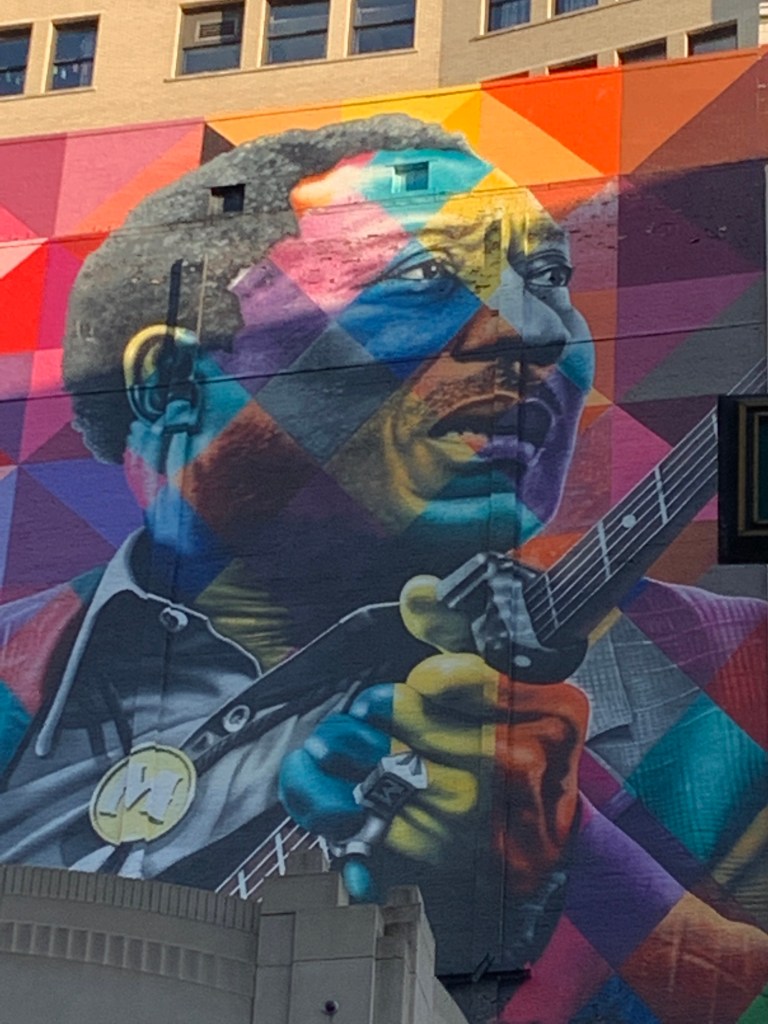
But I always hear Tom’s voice in the back of my head echoing Muddy Waters. The blues had a baby and they named it rock ’n roll. He’s not wrong. The blues is the font of all rock music, and it served my brother well to start there.
To be frank, I’ll never be one-tenth the guitar player Tom was, but he was the one who got me obsessed with rock, obsessed with the blues, and even obsessed with Bruce (he used to play “Racing in the Street” on the old upright piano in my parent’s living room; talented guy).
So, I feel like I owe it to Tom to take a stab at the blues. Don’t be impressed — I’m starting out with some pretty basic stuff, just figuring out typical chords for twelve-bar blues like E7, A7, and B7. It’ll be a long time before I’m anything close to a blues musician.
But I have to say, my brother was right. Even for a complete novice like me, the sound that comes out of that guitar is pretty damn good.
Starndhill, Co. Sligo, with Ben Bulben looming in the background.
A few years ago, I discovered a hip-hop trio from Belfast called Kneecap. At the time, they were not well known in the US, but I was completely fascinated by them. In the years since, Kneecap have become more widely known, due, in part, to their controversial statements about Israel and Gaza and the British government’s attempts to silence them. But that’s not what this post is about.
The reason I remain so fascinated by this group is that they rap in Irish (along with a bit of English, of course). I know the Irish language is still alive, because I’ve been to Ireland a few times and, when you’re there, you see bilingual signs everywhere. Street signs, road signs, signs on public transportation and government buildings, all have Irish words or phrases with English translations below them. And sometimes they’re just in Irish:
Sign on the train from Dublin to Cork.
Anyway, back to Kneecap. It turns out, the Irish language is well suited to rap. Who knew?
Kneecap’s appeal, however, is more than just the novelty of performing a quintessentially American music form — a quintessentially Black American music form, to be precise — in a language that’s largely unknown in America. It’s the fact that they’re rapping in Irish from West Belfast in “Northern Ireland.” Or, as it’s more commonly known in the Republic of Ireland: The North. (Kneecap famously said that “Northern Ireland” is “as real as Narnia.”)
Irish is an official language of the Republic, and even in the North, major universities like the University of Ulster and Queen’s University Belfast offer courses in Irish, but the UNESCO Atlas of the World’s Languages in Danger lists Irish as a language that is “definitely endangered.” So, for three young Irish lads from West Belfast, rapping in Irish is an important way to keep the language alive.
It’s also a revolutionary act. As the band’s Mo Chara and Móglaí Bap explained in a recent interview, destroying indigenous languages has always been a way for colonial powers to erase the culture, ethnicity, and history of colonized peoples. In Ireland, they explained, the British pushed native speakers to the west, away from major economic centers like Dublin and Belfast. In doing so, they cut the Irish people off from their identity, which is what colonialism always does. So rapping in Irish and encouraging their Irish fans to learn the language is a way to reconnect Irish people, in Belfast and elsewhere, with their past, and, by doing so, to destroy one lasting and significant pillar of British colonialism in Ireland.
Coincidentally, a day or two after I came across the interview with Mo Chara and Móglaí Bap, I saw an episode of Will Smith’s documentary series, Pole to Pole, in which he visited some remote islands of Papua New Guinea. In the episode, Will’s guide is a tribal elder and environmental scientist who studies the effects of climate change on the coral reefs indigenous people rely on as their major food source. They also travel to Tench Island (that’s its English, not its indigenous, name), which sits atop a relatively healthy coral reef. While the reef is healthy, Tench Island sits so low in the water that it’s threatened by what local people call “king tides,” massive waves that flood the island and contaminate its fresh water wells, endangering the small community that lives there.
While on Tench Island, Will meets a linguistics expert who’s working to preserve the dozens of indigenous languages spoken across the remote islands of Papua New Guinea. She tells him how important it is to preserve their languages as a means of preserving their history, traditions, and cultural identity. And as he’s speaking with her, Will has an epiphany: It occurs to him that, as descendants of enslaved people, he and most Black Americans lost their ties to their own indigenous languages generations ago. That is to say, colonial powers, through the slave trade, cut off millions of Africans from their language, culture, and traditions, making it extremely difficult for African Americans today to reconnect with the things that gave their ancestors a sense of identity and belonging.
It’s a very emotional moment, and at first it reminded me of Mo Chara’s and Móglaí Bap’s discussion of the English trying to destroy the Irish language in Ireland.
Except that’s a bad analogy for one very important reason: Those of us who claim Irish heritage are not that far removed from our roots, even if our ancestors’ language is endangered. Because, as bad as British colonialism in Ireland was, most of us still know where we came from. Irish emigrés, of course, faced extreme hardship to come to America, leaving behind everything they new. But they left with their sense of ethnicity, their religion, and their traditions intact.
So we, unlike most descendants of enslaved people, still have ties to the place our people came from. I realized the importance of that a few years ago, when I first set foot in County Sligo, where my mother’s family lived several generations ago. Seeing the rolling green hills, watching the river Garavogue flow through Sligo Town in the evening, staring at the Atlantic ocean from the beach at Strandhill, sensing Ben Bulben lurking in the background of every vista … that was pretty profound. I felt at home.
Yet, colonialism and slavery stole that kind of experience from millions of people around the globe. Colonialism and slavery stole their languages, their culture, their religion. Their past.
I’ll never forget that, and I’ll never take for granted the fact that I, unlike many Americans, can hop on a plane and set foot in the place of my mother’s people.
Vernon Reid and Doug Wimbish of Living Colour at City Winery Chicago
I’ve posted a lot about Joe Strummer, the Clash, Bruce Springsteen, and the Pogues lately — all acts that I started listening to decades ago. I’ve been a Springsteen fan for nearly 50 years, a Clash fan for at least 45 years, and the Pogues are the most recent of the bunch: I started listening to them about 40 years ago. I’ve got nothing against new acts, but this is a prerogative that comes with age: you get to a certain point where you are free to revel in the music you love without worrying about staying current.
And as I’ve said (probably too may times, to be fair), current events often bring me back to the music I grounded my values in. My Patron Saints of Rock ’n Roll, like Bruce and Joe.
Anyway, Living Colour is another band I think about all the time. Comprised of four absolute virtuosos — Vernon Reid on guitar, Corey Glover on vocals, Doug Wimbish on bass, and Will Calhoun on drums — they are one of the best (and loudest!) hard rock bands of all time. My wife and I were lucky enough to see them a few years back at City Winery in Chicago, right up next to the stage, and I’m pretty sure my ears are still ringing.
But like the Clash, the Pogues, and Springsteen, aside from making great music, Living Colour is a band that always has something to say. Whether it’s an original song like “Cult of Personality,” “History Lesson,” or “Open Letter (to a Landlord),” or a cover like their incredible take on Notorious B.I.G,’s “Who Shot Ya?,” few bands have been more in tune with social and political issues than Living Colour.
I go back to their music all the time because it’s as educational as it is cathartic. No band plays socially aware hard rock like Living Colour.
So, if you’re not familiar with them or you haven’t listened to their music lately, put the headphones on and crank it up. Your brain will thank you.
And if you like Bruce Springsteen, you’ll be blown away by their cover of “American Skin (41 Shots),” a song that’s more than a little timely these days.
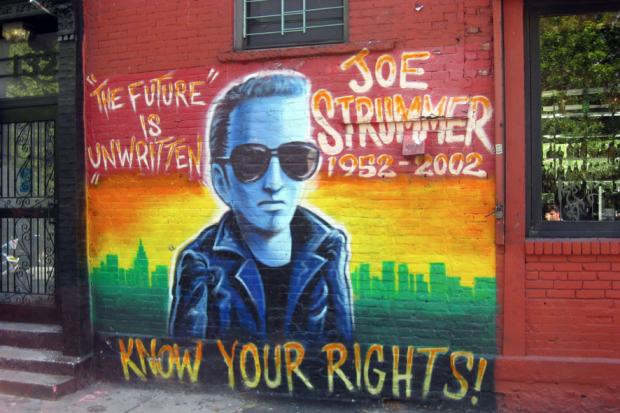
In 2007, filmmaker Julien Temple released a documentary called Joe Strummer: The Future Is Unwritten, which chronicled the musical odyssey of my favorite artist. That title — the future is unwritten — says so much about Joe, from his sneering “teenage git” persona (his words) to his ultimately positive and uplifting message: Without people, you’re nothing.
Joe, despite his punk rock ethos, believed the future was ours to create. Scratch that. Not despite his punk rock ethos; because of his punk rock ethos. Punk rock is activism, and activism is change.
With everything that’s happening in the world today, I’ve thought a lot about Joe’s view of activism. But one thing, in particular, took me all the way back to a lesson from the Clash’s beginning.
During the recent upheaval in Minneapolis, I came a cross a few posts on social media (Threads and Bluesky, in particular) in which white activists expressed a desire to join traditionally Black organizations, like the Black Panthers. In response, I saw what I would describe as an understandably hesitant reaction from Black activists. It’s a complicated subject and I’m in no position to weigh in one way or the other.
But, because nearly everything that happens these days reminds me of a Clash song, I immediately thought of their first single, “White Riot,” released in the UK on March 18, 1977. If that song came out today, I suspect the title might be off-putting, but the story behind the song is fascinating.
Some years back, I came across an interview with Mick Jones and Paul Simonon on the Clash website where they told the story behind the song. The gist of it was this. In the summer of 1976, a white police officer shot a Black man during the annual carnival in a predominantly Black area of London’s Notting Hill. The shooting lit a powder keg of anger and dissatisfaction, and a riot broke out.
Joe and Paul were living nearby, and, as disaffected young punk rockers, they had to check it out. At one point, they found themselves in an alley with a few Black residents of the area. An elder (as I recall the story, wearing a green army jacket) approached Joe and Paul told them, in essence: This is not your fight. Go find your own fight.
As Paul related the story, he and Joe knew what the elder meant. For them, the Notting Hill riot was exciting, dangerous … almost fun. For the Black residents of Notting Hill, it was a life-and-death struggle against oppression. So, the lesson they took from the elder’s comment was this: Don’t co-opt Black activism, but get off the sidelines and create a complimentary movement for white people. Find your own way to fight for the same goals, including both social and economic justice.
That proved to be a seminal moment for Joe Strummer, leading him to write the immortal lines:
Are you taking over
or are you taking orders?
Are you going backwards
Or are you going forwards?
But “white riot,” of course, is a metaphor for activism generally. It doesn’t mean you have to riot to be an activist. If you want to be an activist, you have to figure out what you can do to help the world. That could be volunteering at a food pantry. That could be getting involved in a local civil rights organization. Or, that could be getting out in the street and protesting.
The point is, get off the sidelines and get involved.
After all, the future is unwritten. It’s up to us to write it.
You can read more about the Notting Hill riot and the genesis of “White Riot” here.
Last week I wrote about a popular Christmas song by the Pogues, “Fairy Tale of New York,” and some of its challenging lyrics, so in the interest of fairness, today I’m playing my my all time favorite Pogues’ song, “Thousands Are Sailing,” in honor of My Sainted Irish Mother™, who would be 102 years old today. My mother led a fascinating life, from surviving the Great Depression to working at Naval Station Great Lakes during WWII while my father was overseas with the Army, to raising 11 kids, challenging housing discrimination, and launching a career as a middle school teacher. We lost her in November 2010, but not a day passes when I don’t think of her. While she was proud of her Irish heritage, she never thought it made her better than anyone else. To the contrary, she loved and embraced diversity.
So here’s to you, Mom, and here’s to Ireland. “Where e’er we go we celebrate the land that makes us refugees.”
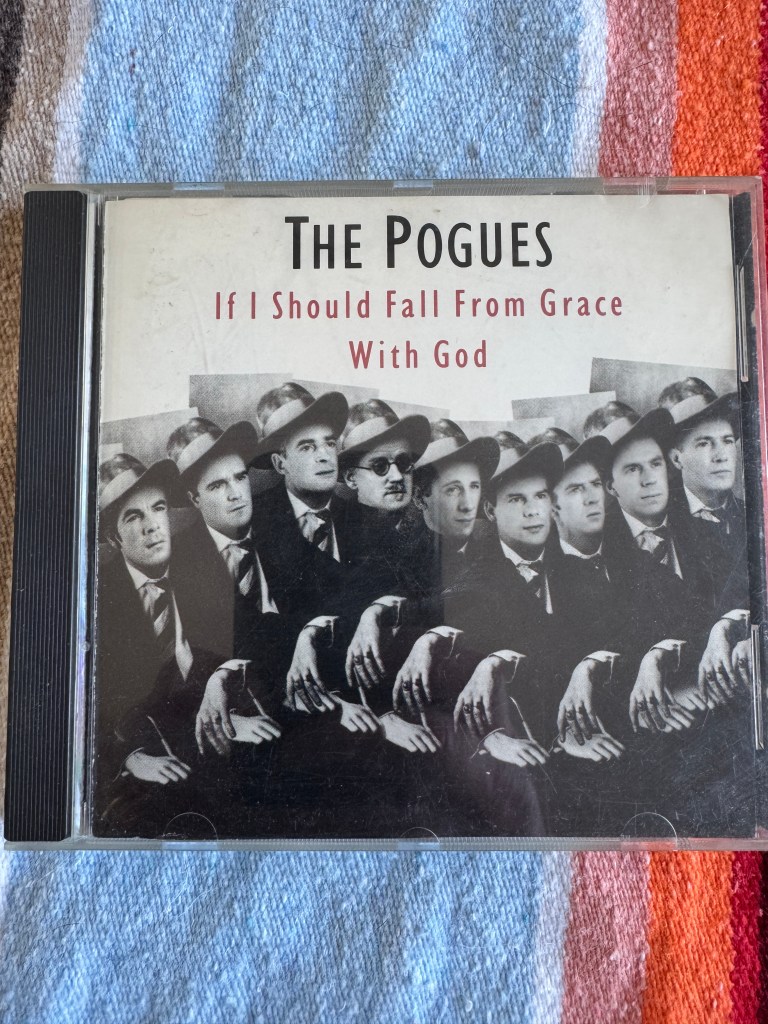
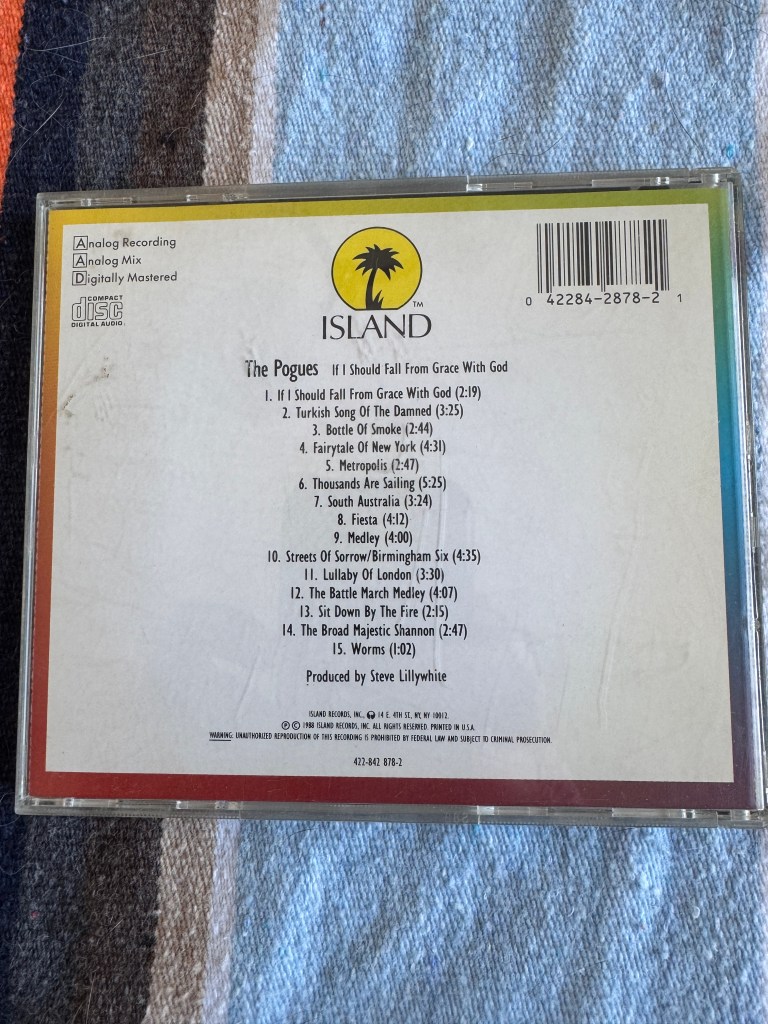
My original CD of the Pogues’ If I Should Fall From Grace With GodThe back of the CD case showing the track listing. “Fairy Tale of New York” is track 4.
I waited until after the holidays to gather my thoughts about everyone’s favorite Irish Christmas song, the Pogues’ “Fairy Tale of New York,” because I’m cool like that. Far be it from me to spoil anyone’s well-intentioned enjoyment of an annual classic. And don’t worry, I won’t spoil it now, because I’ve made peace with it.
*Record scratch*
Let me back up. I first heard “Fairy Tale of New York” not long after it appeared on the band’s 1988 LP, If I Should Fall From Grace With God, and I thought it was fantastic. Incredibly catchy tune, vivid imagery, brilliant lyrics. It is an objectively great song.
Even at the time, though, I was a little shocked by their casual use of a certain homophobic slur — if you’ve heard the song, you know what I’m talking about.
To be fair, while that word jumped out at me, another questionable term in the same verse — slut — slipped right past me without a reaction. So, yes, it was a bit hypocritical of me to react negatively to one slur and not the other.
Still, I’ve spent a lot of time in recent years working with and fundraising for Lambda Legal, an organization that fights for LGBTQ+ rights, so hearing that verse so often during the holidays often feels like a gut punch.
In the Pogues’ defense, they do not try to sugar coat the language of the song, nor do they try, as many Americans do, to claim the word isn’t really a homophobic slur but just a general insult. Instead, as this December 23, 2025 Vice article explains, they acknowledge that the word means what it means, and I appreciate their honesty. Shane MacGowan put it this way:
“The word was used by the character because it fitted with the way she would speak and with her character,” MacGowan said in a 2018 statement, per NME. “She is not supposed to be a nice person, or even a wholesome person. She is a woman of a certain generation at a certain time in history, and she is down on her luck and desperate.”
Fair enough. I read an awful lot of Faulkner and Twain back in high school and college, and this was the common explanation for their repeated use of the n-word: that’s how these characters would have spoken in that time period, so don’t judge the author negatively for writing accurate dialogue. And, for what it’s worth, I never thought Shane or any of the Pogues were homophobic. It’s just that sometimes people who are part of a dominant group don’t perceive how their language affects people in marginalized groups, however unintentional that might be.
And — using the Faulkner/Twain analogy — I think a lot of white southern writers today might be a bit hesitant to drop the n-word so liberally in their works, even in the context of historical dialogue. So maybe it’s good that times change?
But I get the point. The Pogues aren’t saying that it’s okay to call people slurs, they’re writing dialogue that fits the characters in the song. Still, as the Pogues’ Jem Finer explained:
“If those lines were delivered in a play, it would be different, but a song puts words into people’s mouths to drunkenly sing, and they might not even realize what they’re singing, but suddenly it’s in the tube station.”
I guess that’s why I struggled with “Fairy Tale of New York” for so long. Finer’s point reminds me of white kids who love hip hop in no small part because it gives them license to recite n-word-laden verses out loud. Black rappers can use that term for obvious reasons (do I really have to explain this??), but, no, it’s not cool for white teenagers to sing it at the top of their lungs.
Frankly, I worry that some straight Pogues fans might get the same thrill out of, as Finer says, drunkenly singing “Fairy Tale of New York” loudly in public spaces because they think it gives them license to freely drop the f-bomb. (Not that f-bomb, the other f-bomb.) That’s not cool, man.
As I say, though, I’ve made peace with it. I understand why they used the term and the context in which they used it. Artists, especially rock ’n rollers, aren’t and never will be perfect, and if we hold them to a standard of perfection we’ll never be satisfied. Sometimes, you have to let these things go, so I’m letting this go.
One last thing. When I say I’m letting this go, I’m speaking only for myself. Language and art affect everyone differently, so everyone has to make up their own mind about what they can and can’t tolerate, whether it’s in a song’s lyrics or in any other context. I don’t expect everyone to agree with me on either point — that the song is problematic in the first place, or that I choose to let it go — because I don’t think there’s one right answer. That’s how art works. Everyone has to think for themselves.
But I promise not to drunkenly sing “Fairy Tale of New York” in a tube station. For a whole lot of reasons.
Maybe it’s good that we’ve been through nightmares like this before?
But sometimes it’s just too much.
So, instead of tuning in and losing my mind, I spent some time over the past few days doing something that’s oddly relaxing. I restrung my guitars.
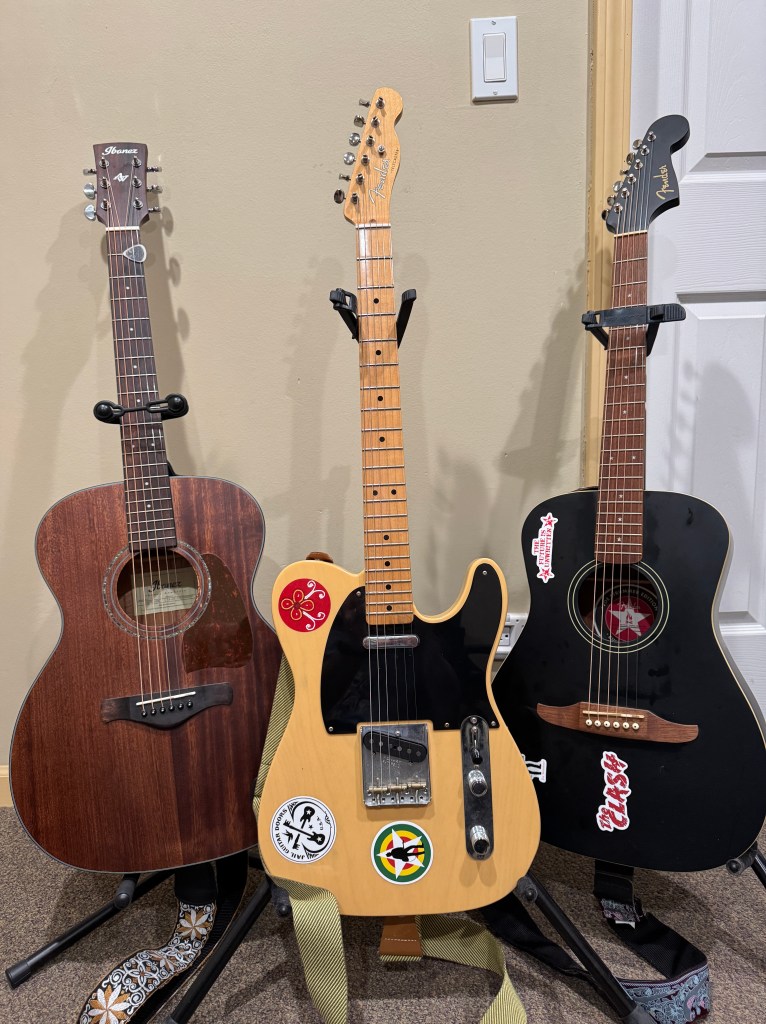
Not that I have a huge collection. I have exactly three: an Ibanez Art Wood acoustic, a Fender Telecaster, and a Fender Joe Strummer edition Campfire acoustic.
Anyway, I’m no luthier, but there’s something about the process of restringing a guitar that’s kind of therapeutic. It’s not complicated work, but it requires some concentration and some patience. I prefer to remove all of the strings and then put the new ones on, from the sixth string (low E) to the first string (high E). Some more experienced guitar players prefer to replace each string individually, but there’s no magic to the process. It’s just removing the old string, replacing it with the new, stretching it a bit, and winding it around the tuner until it’s in tune. And then the most satisfying part of all: snipping the excess string off the end, so the newly installed string is nice and tightly wound around the tuning peg.
If you allow just enough slack to begin with, then wind the peg till the string is in tune, it’s likely to stay in tune for a while.
It’s such a satisfying process — just the right balance of work between your hands and your brain — and nothing sounds better than a freshly restrung guitar.
As long as it’s in tune.
Once I restring my guitars, I check the tuning against the app on my phone, and then I try them out. My song of choice lately is “The Promised Land” from Bruce Springsteen’s 1978 album, Darkness on the Edge of Town. And maybe “Youngstown.” And “Racing in the Street.” And, aw, what the heck, let’s throw a little Clash in there, too. “London Calling” or “Death or Glory.” They all sound great on fresh strings.
Which is not to say that I won’t waste some time doom-scrolling tomorrow, or the next day, or the next day. It’s just that, sometimes, all you can do is put some fresh strings on your guitar and play a little rock ’n roll. The bad news’ll wait.





 Elvis Ate Dynamite