A few years ago, I discovered a hip-hop trio from Belfast called Kneecap. At the time, they were not well known in the US, but I was completely fascinated by them. In the years since, Kneecap have become more widely known, due, in part, to their controversial statements about Israel and Gaza and the British government’s attempts to silence them. But that’s not what this post is about.
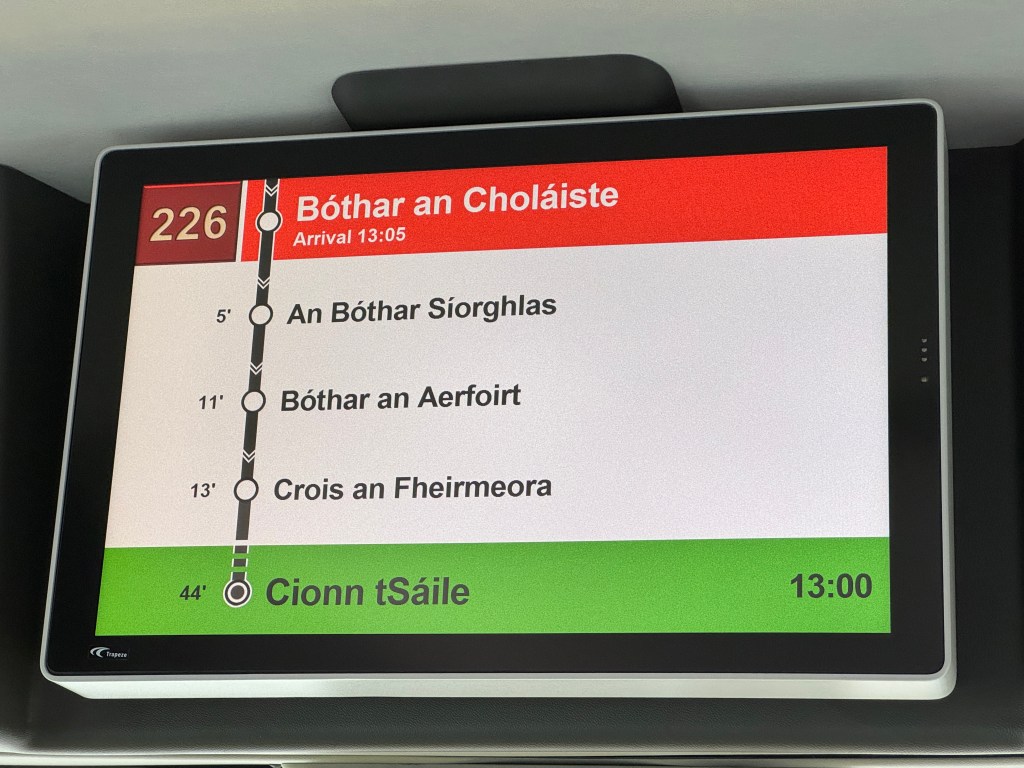
The reason I remain so fascinated by this group is that they rap in Irish (along with a bit of English, of course). I know the Irish language is still alive, because I’ve been to Ireland a few times and, when you’re there, you see bilingual signs everywhere. Street signs, road signs, signs on public transportation and government buildings, all have Irish words or phrases with English translations below them. And sometimes they’re just in Irish:
Anyway, back to Kneecap. It turns out, the Irish language is well suited to rap. Who knew?
Kneecap’s appeal, however, is more than just the novelty of performing a quintessentially American music form — a quintessentially Black American music form, to be precise — in a language that’s largely unknown in America. It’s the fact that they’re rapping in Irish from West Belfast in “Northern Ireland.” Or, as it’s more commonly known in the Republic of Ireland: The North. (Kneecap famously said that “Northern Ireland” is “as real as Narnia.”)
Irish is an official language of the Republic, and even in the North, major universities like the University of Ulster and Queen’s University Belfast offer courses in Irish, but the UNESCO Atlas of the World’s Languages in Danger lists Irish as a language that is “definitely endangered.” So, for three young Irish lads from West Belfast, rapping in Irish is an important way to keep the language alive.
It’s also a revolutionary act. As the band’s Mo Chara and Móglaí Bap explained in a recent interview, destroying indigenous languages has always been a way for colonial powers to erase the culture, ethnicity, and history of colonized peoples. In Ireland, they explained, the British pushed native speakers to the west, away from major economic centers like Dublin and Belfast. In doing so, they cut the Irish people off from their identity, which is what colonialism always does. So rapping in Irish and encouraging their Irish fans to learn the language is a way to reconnect Irish people, in Belfast and elsewhere, with their past, and, by doing so, to destroy one lasting and significant pillar of British colonialism in Ireland.
Coincidentally, a day or two after I came across the interview with Mo Chara and Móglaí Bap, I saw an episode of Will Smith’s documentary series, Pole to Pole, in which he visited some remote islands of Papua New Guinea. In the episode, Will’s guide is a tribal elder and environmental scientist who studies the effects of climate change on the coral reefs indigenous people rely on as their major food source. They also travel to Tench Island (that’s its English, not its indigenous, name), which sits atop a relatively healthy coral reef. While the reef is healthy, Tench Island sits so low in the water that it’s threatened by what local people call “king tides,” massive waves that flood the island and contaminate its fresh water wells, endangering the small community that lives there.
While on Tench Island, Will meets a linguistics expert who’s working to preserve the dozens of indigenous languages spoken across the remote islands of Papua New Guinea. She tells him how important it is to preserve their languages as a means of preserving their history, traditions, and cultural identity. And as he’s speaking with her, Will has an epiphany: It occurs to him that, as descendants of enslaved people, he and most Black Americans lost their ties to their own indigenous languages generations ago. That is to say, colonial powers, through the slave trade, cut off millions of Africans from their language, culture, and traditions, making it extremely difficult for African Americans today to reconnect with the things that gave their ancestors a sense of identity and belonging.
It’s a very emotional moment, and at first it reminded me of Mo Chara’s and Móglaí Bap’s discussion of the English trying to destroy the Irish language in Ireland.
Except that’s a bad analogy for one very important reason: Those of us who claim Irish heritage are not that far removed from our roots, even if our ancestors’ language is endangered. Because, as bad as British colonialism in Ireland was, most of us still know where we came from. Irish emigrés, of course, faced extreme hardship to come to America, leaving behind everything they new. But they left with their sense of ethnicity, their religion, and their traditions intact.
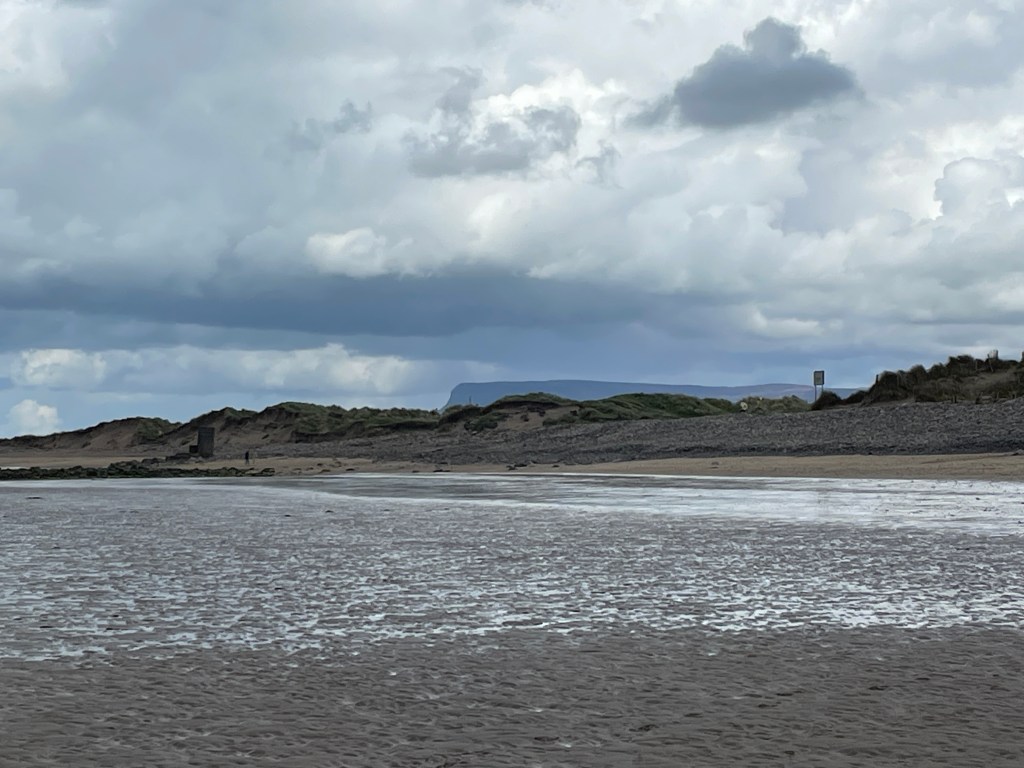
So we, unlike most descendants of enslaved people, still have ties to the place our people came from. I realized the importance of that a few years ago, when I first set foot in County Sligo, where my mother’s family lived several generations ago. Seeing the rolling green hills, watching the river Garavogue flow through Sligo Town in the evening, staring at the Atlantic ocean from the beach at Strandhill, sensing Ben Bulben lurking in the background of every vista … that was pretty profound. I felt at home.
Yet, colonialism and slavery stole that kind of experience from millions of people around the globe. Colonialism and slavery stole their languages, their culture, their religion. Their past.
I’ll never forget that, and I’ll never take for granted the fact that I, unlike many Americans, can hop on a plane and set foot in the place of my mother’s people.


Leave a Reply