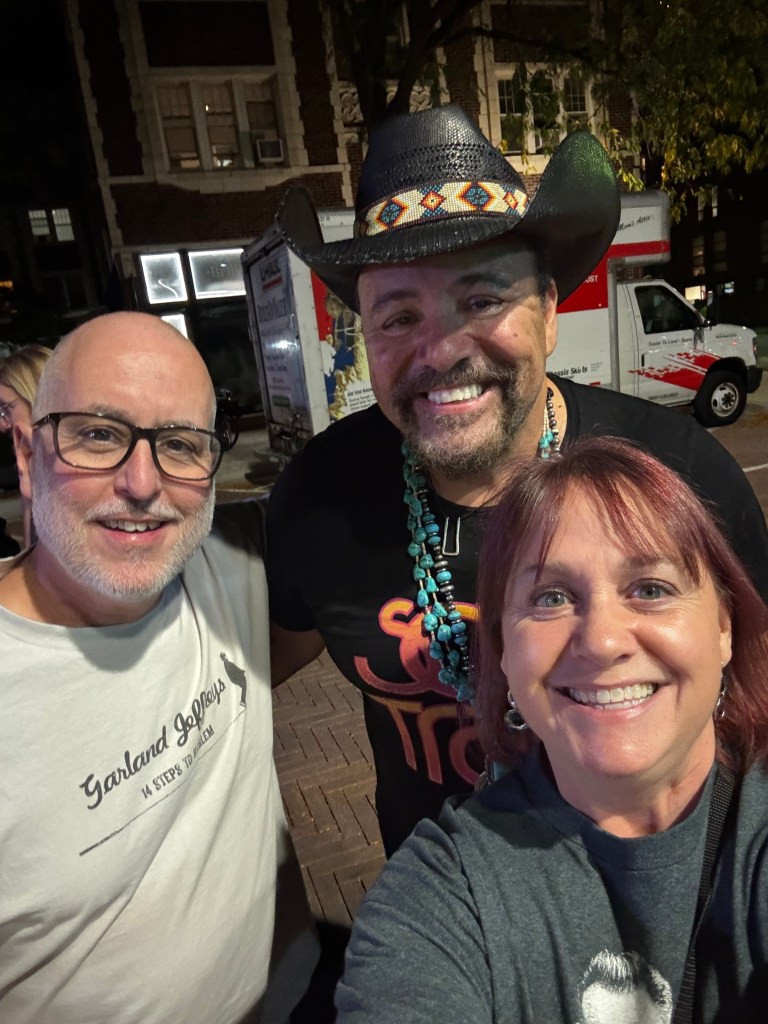
Photo: Jennifer and I hanging out with Terrance Simien after a show, Sept. 2025.
And it turns out, she still does.
Thirty-two years ago, on the night before Thanksgiving, I met Jennifer, my wife-to-be, in a bar on Madison Street in Forest Park, Illinois. Appropriately enough, we met by the jukebox where my longtime friend Joel insisted that I help her pick out a few songs, which must have seemed really strange to her.
Despite that potentially awkward introduction, Jennifer stuck with me, and from the beginning, music played a central role in our relationship.
In our early years, we saw some great shows at FitzGerald’s Nightclub, a legendary venue in the western suburbs of Chicago, including C.J. Chenier, Terrance Simien, and a band that we would follow for decades to come: The Mavericks, a Latin-influenced alt-country band out of Miami. Not long after that show, the Mavericks were all over the country music awards shows, and their career really took off.
But then, of course, we started having kids, and both money and time were in short supply. So, we took an involuntary hiatus from concert-going for … well … a long time. I like to say that until the mid twenty-teens, my last relevant cultural reference was Pearl Jam’s Vitalogy album, released in 1994, followed by an endless stream of Pixar movies and Nickelodeon.
Not that that’s a bad thing.
Eventually, however, you emerge from that fog. Once our kids were older and we had a little more disposable income, we reconnected with pop culture in general and music in particular. Especially concerts.
In addition to seeing Garland Jeffreys on several occasions (as I’ve mentioned before), we’ve seen, in no particular order, Keb’ Mo’, Little Steven and the Disciples of Soul, Living Colour, the Mavericks (five or six times), Los Lobos (twice), John Hiatt, Rosanne Cash (twice), LP, Bob Mould, Raul Malo (of Mavericks fame), Taj Mahal, Graham Parker, Southside Johnny and the Asbury Jukes (twice), James Maddock, Jake Clemons, Steve Earle, Terrance Simien (again), Dwight Yoakam … and we traveled to Dublin to see Bruce Springsteen twice.
And then there was that guy at a pub called Sin é in Cork City who played “The City of New Orleans,” by Chicago’s own Steve Goodman (a song John Prine called “the best damn train song ever wrote”). That guy — the Irish singer — didn’t care for Bruce Springsteen, but to each their own.
Anyway, that may not be not a lot of concerts for you youngsters, but for a couple of old folks (well, I’m old, anyway), that’s not too bad.
Oh, and I almost forgot! We also took several guitar classes together at Old Town School of Folk Music, another Chicago institution.
So, needless to say, it’s been a pretty spectacular 32 years! I may not make it another 32, but I’m looking forward to the next concert. And the one after that. And the one after that.
And I promise not to commandeer any jukeboxes from here on out.
Bruce Springsteen sings “I’ll See You in My Dreams” in Dublin
Most of the artists I listen to are a good 10 to 15 years older than I am. Joe Strummer, for example, was born in 1952, 10 years before I was, and had he not met an untimely end at age 50, he’d still be making records and I would still be buying them.
That age gap makes sense, because musicians usually start playing in bands and writing songs when they’re in their teens, and they continue to write for a teenage audience as they progress through the early stages of their careers. An artist might be 25 years old when they sign their first record contract, but they don’t make that debut album for their fellow 25 year olds.
Of course, as artists get older, so does their core audience, and so does their subject matter. They start writing songs about having kids and paying bills and worrying about the future. And a funny thing happens to the age gap between artists and their audiences: it begins to collapse. When you’re 10 and an artist is 20, you’re half their age. By the time you hit 20 and they’re 30, you’re two-thirds their age, and when you’re 40 and they’re 50, you’re 80% of their age.
And so it goes.
Eventually, you start losing family and friends, and, sure enough, they start writing songs about losing family and friends. And songs about facing their own mortality.
I mentioned Garland Jeffreys the other day. In 2011, he wrote a song called “Till John Lee Hooker Calls Me” where he contemplates mortality but is still not ready to put down the microphone. But on that same album, The King of In Between, he also wrote a song called “In God’s Waiting Room.”
Then there’s Bruce Springsteen with the trifecta of death-contemplating songs: “Last Man Standing,” “Ghosts,” and “I’ll See You in My Dreams” — all of which he regularly performs in concert these days. He knows nothing lasts forever and he’s trying to teach us how to cope.
The next phase is when the artists you’ve listened to for a half century or more start to pass on. A lot of musicians die young, of course, either from their own self-destructive tendencies or as a result of unknown health risks, like Joe Strummer’s undiagnosed heart condition. (Granted, Strummer was 50, but that’s still way too young.)
So here we are, watching the great ones go. Prince. Tom Petty. Aretha Franklin. Tina Turner. Sinead O’Connor. Ozzie. Jimmy Cliff. And one of my all-time favorites: Shane MacGowan of the Pogues.
When we saw Bruce Springsteen at Croke Park in Dublin in 2024, I braced myself for the final number. This was his third show in Ireland, so I already knew what to expect. Not “I’ll See You in My Dreams,” though he played that too, but a rousing, tearful cover of “A Rainy Night in Soho.” It was cathartic even though we all knew it was coming:
We watched our friends grow up together
And we saw them as they fell
Some of them fell into Heaven
Some of them fell into Hell
There’s plenty more to say about growing older with your favorite musicians, but I’ll leave you with this. Though I have a pretty good idea what the future holds, I’m not ready to let some of them go.
I woke up this morning to the news that reggae legend Jimmy Cliff passed away at age 81. What a tremendous loss for the music world in general. I posted this quick video on Instagram on my YouTube channel, so I thought I would share it here, too. I first came to reggae through the soundtrack to the 1972 film The Harder They Come, which starred Jimmy Cliff and featured much of his music, along with other reggae giants like Desmond Dekker and Toots & the Maytals.
Jimmy’s influence spread well beyond Jamaica and well beyond reggae. He had a major impact on Joe Strummer and the Clash, inspiring these great lines from the song “Guns of Brixton” off the London Calling LP:
Today’s installment of Black Coffee and Electric Guitars features a very un-Clash-like Clash song, “Hitsville U.K.,” from the 1980 triple album, Sandinista!
The song’s lyrics epitomize the DIY spirit of early punk rock, but it has a very different sound, with organs and marimbas front and center. Nonetheless, it’s pretty straightforward and fun to play on guitar.
The version I found online uses just four chords: C, F, G and Am.
The opening verse is:
C F C
They cried the tears, they shed the fears
F C F G
Up and down the land
C F C
They stole guitars or used guitars
F C Am
So the tape would understand
F G C F
Without even the slightest hope of a 1000 sales
G F
Just as if, as if there was, a hitsville in U.K.
C F G C
I know the boy was all alone, til the hitsville hit U.K.
The remaining verses follow that same basic pattern. For example verse two:
C F C
They say true talent
F C F G
Will always emerge in time
C F C
When lightning hits small wonder
F C Am
Its fast rough factory trade
F G
No expense accounts, or lunch discounts
C F
Or hyping up the charts
F G C F
The band went in, ’n knocked ’em dead, in 2 min. 59
C F G C
I know the boy was all alone, til the hitsville hit U.K.
And then the outro repeats these lyrics until the end:
C F C
Now the boys and girls are not alone
F G C
Now the hitsville’s hit U.K.
So why this song?
As I’ve mentioned before, my late brother John turned me on to the Clash way back when, and one persistent memory I have is driving around in his car running errands in the early summer of 1981 when “Hitsville U.K.” came on the radio. To be honest, up to that point I didn’t quite know what to make of Sandinista!, because I was mostly familiar with their self-titled debut album and London Calling, which were quite different. But John loved it, and I still remember him raving about while we drove around the suburbs. Anyway, John’s praise for Sandinista! opened my mind to what the Clash really stood for, which was constant change and challenging old ways of thinking. And that, really, is the essence of the Sandinista! album.
Mick Jones once joked that Sandinista! had “a lot of marimbas for a punk album,” and that’s true, but that’s what made the Clash so much better than the average punk band. So, thanks, John, for an important musical lesson.
Happy Friday. Today’s song is “Born to Lose” from Social Distortion’s 1992 album, Somewhere Between Heaven and Hell. Inspired by Bruce Springsteen covering Social D’s “Bad Luck” from that same LP (with a guest appearance by Mike Ness) and the, shall we say, plethora of capos in that video, I came up with a work-around for the three main chords in “Born to Lose” — D#, G#, and A#. Have a great weekend, everybody!
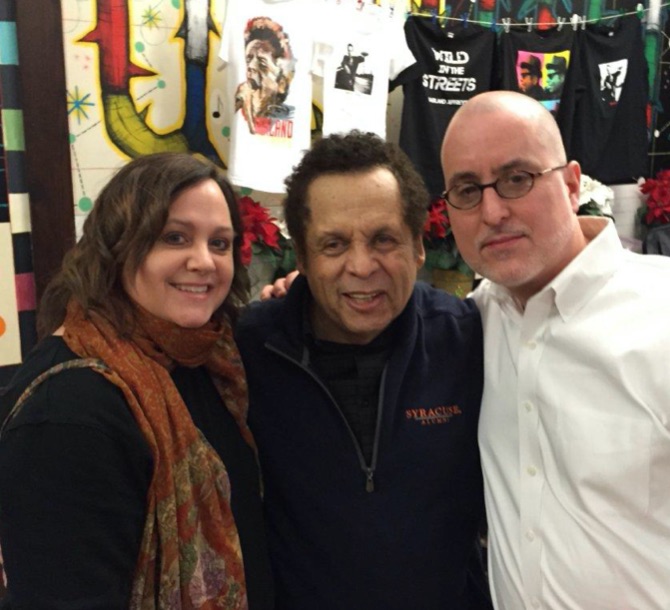
Hanging out with Garland after his show at Old Town School of Folk Music in Chicago, January 2016
If you’ve looked at some of my recent posts, you might get the impression that this is a Bruce Springsteen fan page, but it’s not. Well, it kind of is, in that Bruce had a pretty big impact on me, I’ve seen him play live multiple times, and I play … let’s just say lots of Springsteen songs on the guitar.
I swear, though, I have musical interests other than Bruce, and I plan to write about them, too.
But since I’m on the topic, I thought I’d write about what I call the Springsteen-adjacent artists I’ve followed for years. There’s Little Steven, of course, whose Disciples of Soul records I bought when they came out in the ’80s. And Southside Johnny and the Asbury Jukes, who were one of the opening acts for the Rolling Stones when I saw them at Soldier Field in 1978. How can you not love a polyester-suit-clad nine-piece band with a horn section blasting their way through “The Fever” and “I Don’t Want to Go Home” at 11:30 a.m. in the blazing heat of a Saturday in July.
And then there’s Garland Jeffreys, perhaps less known than the others but no less influential, in my book. Garland got some early airplay with a song called “Wild in the Streets,” and then scored a pretty successful 1981 album, Escape Artist (featuring, as was the tradition at the time, members of the E Street Band). Escape Artist resulted in a few videos that showed up on MTV from time to time and featured “R.O.C.K.,” a song that Chicago radio legend Lin Brehmer (may he rest in peace) called “the greatest song ever written.” (Lin Brehmer had about a dozen songs he called “the greatest song ever written,” like “Gimme Shelter,” but “R.O.C.K.” was one of them.) In the 1990s, Garland’s Don’t Call Me Buckwheat had some modest success, thanks to the hip-hop inspired “Hail, Hail Rock ’n’ Roll” and at least one appearance on David Letterman.
I came to know Garland’s music through my late brother John, who also turned me on to Southside Johnny. John is also the reason I became a Clash fanatic, but more on that later.
Anyway, here’s where the story takes an unexpected twist. Not long after he released Don’t Call Me Buckwheat, Garland took a break from touring and recording, releasing only two new albums — Wildlife Dictionary and I’m Alive — over the next 15 years. And then, in 2011, he came roaring back with a fantastic album called The King of In Between, an apt description for an artist with Black and Puerto Rican roots who always straddled America’s racial divide.
Now 2011 was a different time in the social media world and Garland (or, most likely, Garland’s lovely wife, Claire) quickly learned how to use it to promote his comeback. So, as it turns out, I stumbled across Garland’s Facebook and Twitter pages and I began to interact with him. As I say, this was a different time, and artists were more inclined to engage in social media conversations with their fans. So, he followed me back and we became acquainted. Or, as acquainted as you can be over social media.
Then, in July 2012, Garland played the Square Roots Festival in Chicago, and my wife and I had our first opportunity to see him live. The first opportunity of many, as it turns out, because after the show my wife decided that we should strike up a conversation with him — something I would never do! — and so we did.
Long story short, we ended up becoming friends with Garland and Claire and we saw him play live every time he came to Chicago after that. We even traveled to New York in June 2019 to see his final performance, an all-star show featuring Laurie Anderson, Vernon Reid, Ivan Julian, Chuck Prophet, Willie Nile, and more.
Not long after that show, we learned why Garland retired from touring (this is now public information, by the way): he has Alzheimers.
But I don’t want to dwell on that. I want to remember my friend Garland, who was the most gracious musician I’ve ever known. He welcomed two strangers from Chicago with open arms and genuinely embraced us as fans, yes, but also as friends.
If you want to learn more about Garland’s career, check out the excellent documentary Claire Jeffreys put together, Garland Jeffreys: The King of In Between. It chronicles his life in music and features interviews with any number of celebrities and music industry figures, from Harvey Keitel to (yes, of course!) Bruce Springsteen. The film shows just how influential Garland was, despite never achieving the success he deserved.
Meanwhile, we’re sending love and positivity to Garland, Claire, and their daughter Savannah. It’s been a wild ride, but I’m so glad we got to know you.
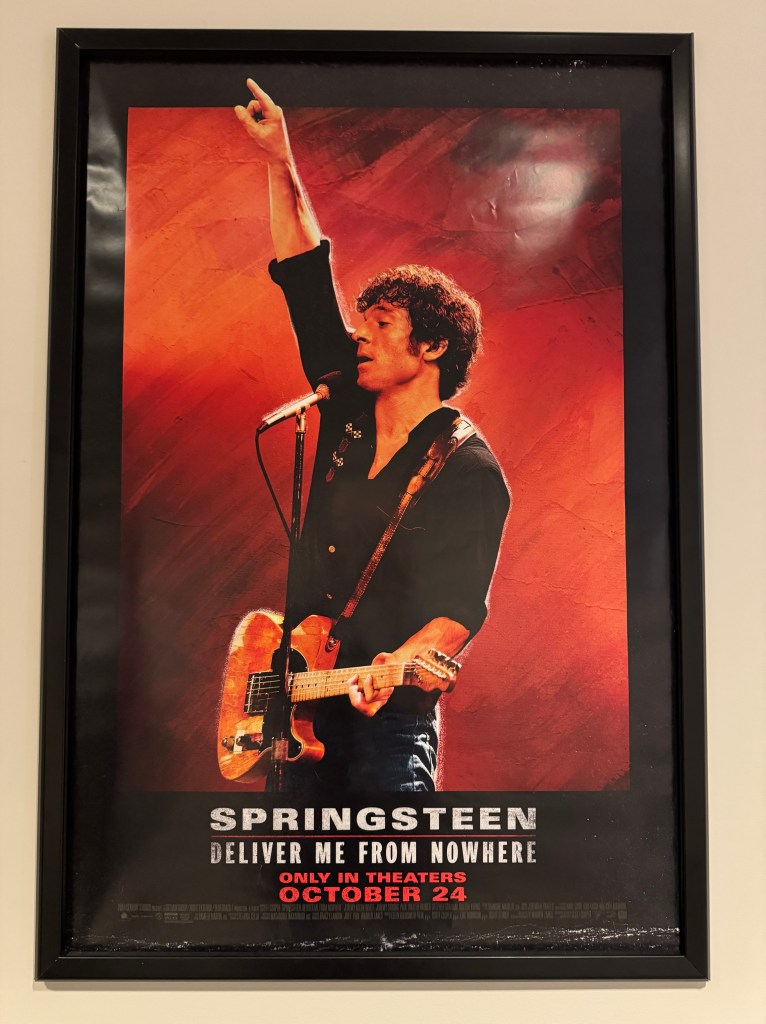
As I mentioned yesterday, we finally got around to seeing Springsteen: Deliver Me From Nowhere, the biopic that covers the period when Bruce recorded and released the solo, mostly acoustic Nebraska LP. For us old timers, that album holds a special place in our hearts.
But, as I said, the movie is about more than making a record. It’s also about struggling with mental illness and accepting help. And, as with so many of us, the vehicle that guided Bruce down that path was friendship. Specifically, his friendship with his manager, John Landau, and his childhood friend, Matt Delia.
Landau, in particular, accepts Bruce for who he is and supports him without reservation on the bizarre journey that led to releasing Nebraska as Bruce originally recorded it — a four-track demo on a cassette tape without a cover. But as supportive as Landau is in the film, he doesn’t enable Bruce’s mental illness. He listens without judgment, but also watches Bruce closely. He chooses his words carefully. And, most importantly, when Delia calls Landau from a payphone after Bruce has a breakdown, for lack of a better term, on the road to California, Landau has the courage to tell Bruce: You need professional help.
That’s not some reality TV nonsense. That’s true friendship. You cannot develop that level of trust and credibility without being extraordinarily close to someone. The proof of that is this: Bruce takes his advice and starts seeing a therapist.
The funny thing is, I always credited artists like Bruce Springsteen with keeping me sane during those challenging teenage years when I didn’t know who or what I was, other than someone who didn’t fit in and always felt out of place. Because his music was all about being an outsider and not fitting in, and knowing that somebody like Bruce understood what that felt like … man, that was powerful.
In the end, of course, he wrote those songs because he was just like the rest of us, except that he was a better storyteller. He was an outsider. He didn’t know where he fit in. But he had enduring friendships that helped him navigate that path and finally get help.
A few months ago, my wife and I were driving back from our old stomping grounds after spending a few hours with some friends I’ve known since I was in high school nearly 50 years ago. It’s a long drive back to our place in the far northern suburbs of Chicago. But, anyway, there were were, in the car, and it suddenly dawned on me that this group of friends with very disparate backgrounds and life experiences were the people who helped me navigate a similar path. They were and are friends to the core. No judgment. Just friendship and support. They always met me where I was and never asked me to be someone I wasn’t.
What an extraordinary thing.
Like Bruce, it took me a long time to sort things out and fix things that needed fixing. And like Bruce, I was lucky enough to have friends who gave me the time and space to figure it all out. Well, to figure most of it out, anyway. There’s always more work to do.
After a handful scheduling conflicts over the past few weekends, my wife and I finally saw the Bruce Springsteen biopic, Springsteen: Deliver Me From Nowhere, on Saturday.
Here’s the short version of my review: I liked it.
Here’s the much longer version. First, I recognize that it hasn’t made much money at the box office and that the reviews have been mixed. That’s okay for at least a couple of reasons. For one thing, while Springsteen fans genuinely love the guy, we’re not a cult. We don’t think he’s perfect and we get that he’s not for everyone. To us, Bruce’s imperfections make him more relatable.
More to the point, though, the movie may not resonate with everyone because it’s about a very specific time in his career — the period between the end of his 1980-81 tour in support of The River and the release of the Nebraska album in 1982. If you’ve read the Warren Zanes book the movie’s based on, that was a particularly challenging time in Bruce’s life.
But for some of us of (ahem) a certain age, that same time period, the early 1980s, was a pretty significant and challenging time in our lives, too.
The first time I saw Bruce play live was on the River tour. I was a freshman at the University of Illinois in Urbana-Champaign when they came through town in February 1981. So, it’s fair to say that that album and that tour had a huge impact on my understanding of what rock music could be.
Then Nebraska came out in September 1982, early in my junior year. This was a time when many of us, like Springsteen himself, were looking for something new and challenging. A few years later, a friend of mine would observe that by the 1980s, rock music had “matured,” and he didn’t mean that in a good way. But that’s how it felt to a lot of us. We didn’t know exactly what we wanted, but most of what we heard on the radio … wasn’t it.
Springsteen wasn’t alone in searching for something new. Punk rock was still emerging; the Clash and the Ramones were still kicking ass. Hip-hop was on the verge of exploding into everyone’s consciousness. All of it was revolutionary.
And Nebraska, in a way, was a punk album. It didn’t have a punk sound, but it certainly had a punk feel.
To me, what Bruce did with that album is a lot like what early punk and hip-hop artists did. I don’t quite know how to explain it, but it’s like they traveled back in time to find that one essential thing — that spark — that was there at the inception of the most vital and influential types of American music, and they brought it back with them. Early rock ’n roll, pre-commercial country, folk, blues, and R&B. They all had something vital and alive, and by the 1980s, the music business seemed to have crushed it out of them.
So, that was how Nebraska landed. I bought it on cassette (which was something I rarely did back then, but if you seen the film, it’s kind of appropriate), I put it in the cassette deck, donned those oversized, avocado-colored Koss headphones, and hit play.
It was mesmerizing. I knew I was listening to something I’d never heard before. But it was oddly familiar, just like the first time I heard, say, “Sheena Is a Punk Rocker” or “Career Opportunities.” Bruce, that guitar, that harmonica, the echo-y, scratchy sound. It was the realest thing I’d ever heard. It was dark, foreboding, a little scary, but mostly it was alive.
Springsteen: Deliver Me From Nowhere has a lot more that warrants discussion, and I plan to circle back to it over the coming days. It’s not just a film about music. It’s a film about mental illness and finally knowing how to ask for help. I know a thing or two about that. And it’s a film about friendship — about having friends who are always there for you, who don’t judge you, and who stay with you throughout your life. I know a thing or two about that as well.
Those are important topics in the film; in some ways, the most important topics in the film. But for tonight, I wanted to focus on the music and what Nebraska meant to me when it came out.
A day doesn’t go by when I don’t think of these lines from “Open All Night,” still my favorite song on Nebraska: “Radio’s jammed up with gospel stations/Lost souls calling long-distance salvation/Hey, Mr. Deejay, won’t you hear my last prayer/Hey, ho rock ’n roll, deliver me from nowhere …”
Neil Young, the world’s coolest Canadian, is 80 years young today, so I had to play a “deep cut,” as the kids say: “T-Bone” from the 1981 album, Reactor, which consists of these and only these lyrics:
Got mashed potatoes
Got mashed potatoes
Got mashed potatoes
Ain’t got no t-bone
Ain’t got no t-bone …
Now, a lesser artist could not pull this off, but he’s Neil Young. Hippie. Punk. New wave rocker. Activist. Environmentalist. All around cool dude.


 Elvis Ate Dynamite