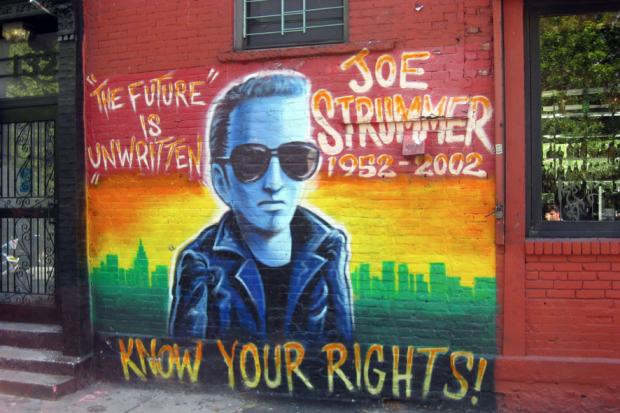
In 2007, filmmaker Julien Temple released a documentary called Joe Strummer: The Future Is Unwritten, which chronicled the musical odyssey of my favorite artist. That title — the future is unwritten — says so much about Joe, from his sneering “teenage git” persona (his words) to his ultimately positive and uplifting message: Without people, you’re nothing.
Joe, despite his punk rock ethos, believed the future was ours to create. Scratch that. Not despite his punk rock ethos; because of his punk rock ethos. Punk rock is activism, and activism is change.
With everything that’s happening in the world today, I’ve thought a lot about Joe’s view of activism. But one thing, in particular, took me all the way back to a lesson from the Clash’s beginning.
During the recent upheaval in Minneapolis, I came a cross a few posts on social media (Threads and Bluesky, in particular) in which white activists expressed a desire to join traditionally Black organizations, like the Black Panthers. In response, I saw what I would describe as an understandably hesitant reaction from Black activists. It’s a complicated subject and I’m in no position to weigh in one way or the other.
But, because nearly everything that happens these days reminds me of a Clash song, I immediately thought of their first single, “White Riot,” released in the UK on March 18, 1977. If that song came out today, I suspect the title might be off-putting, but the story behind the song is fascinating.
Some years back, I came across an interview with Mick Jones and Paul Simonon on the Clash website where they told the story behind the song. The gist of it was this. In the summer of 1976, a white police officer shot a Black man during the annual carnival in a predominantly Black area of London’s Notting Hill. The shooting lit a powder keg of anger and dissatisfaction, and a riot broke out.
Joe and Paul were living nearby, and, as disaffected young punk rockers, they had to check it out. At one point, they found themselves in an alley with a few Black residents of the area. An elder (as I recall the story, wearing a green army jacket) approached Joe and Paul told them, in essence: This is not your fight. Go find your own fight.
As Paul related the story, he and Joe knew what the elder meant. For them, the Notting Hill riot was exciting, dangerous … almost fun. For the Black residents of Notting Hill, it was a life-and-death struggle against oppression. So, the lesson they took from the elder’s comment was this: Don’t co-opt Black activism, but get off the sidelines and create a complimentary movement for white people. Find your own way to fight for the same goals, including both social and economic justice.
That proved to be a seminal moment for Joe Strummer, leading him to write the immortal lines:
Are you taking over
or are you taking orders?
Are you going backwards
Or are you going forwards?
But “white riot,” of course, is a metaphor for activism generally. It doesn’t mean you have to riot to be an activist. If you want to be an activist, you have to figure out what you can do to help the world. That could be volunteering at a food pantry. That could be getting involved in a local civil rights organization. Or, that could be getting out in the street and protesting.
The point is, get off the sidelines and get involved.
After all, the future is unwritten. It’s up to us to write it.
You can read more about the Notting Hill riot and the genesis of “White Riot” here.
 Elvis Ate Dynamite
Leave a comment