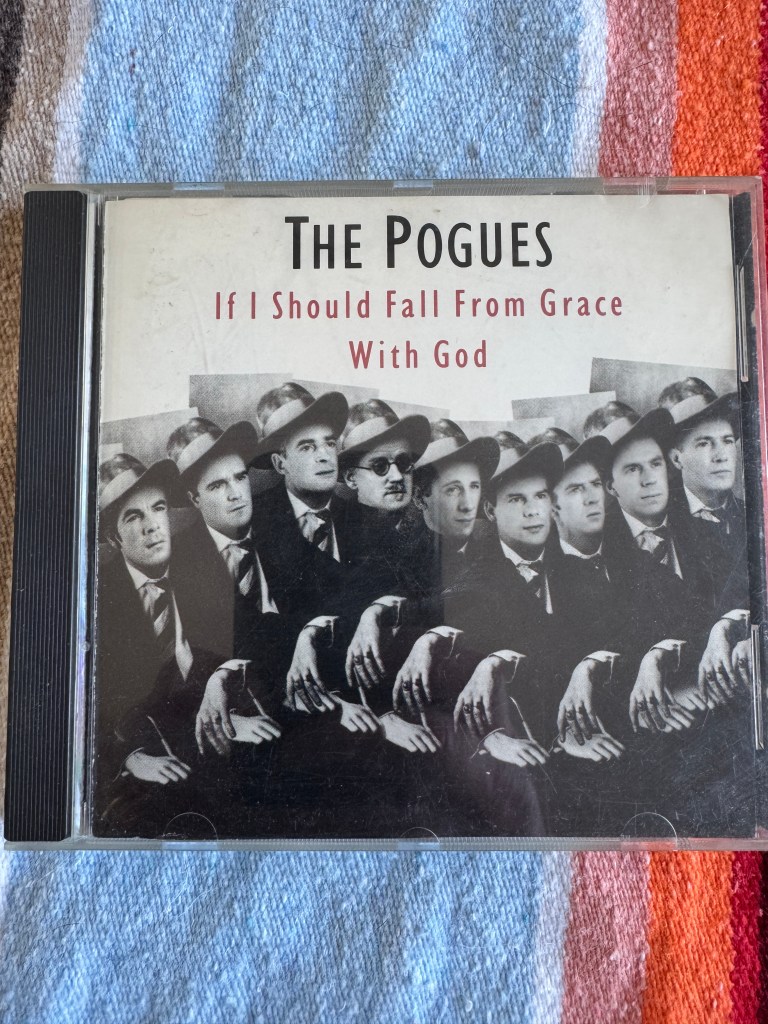
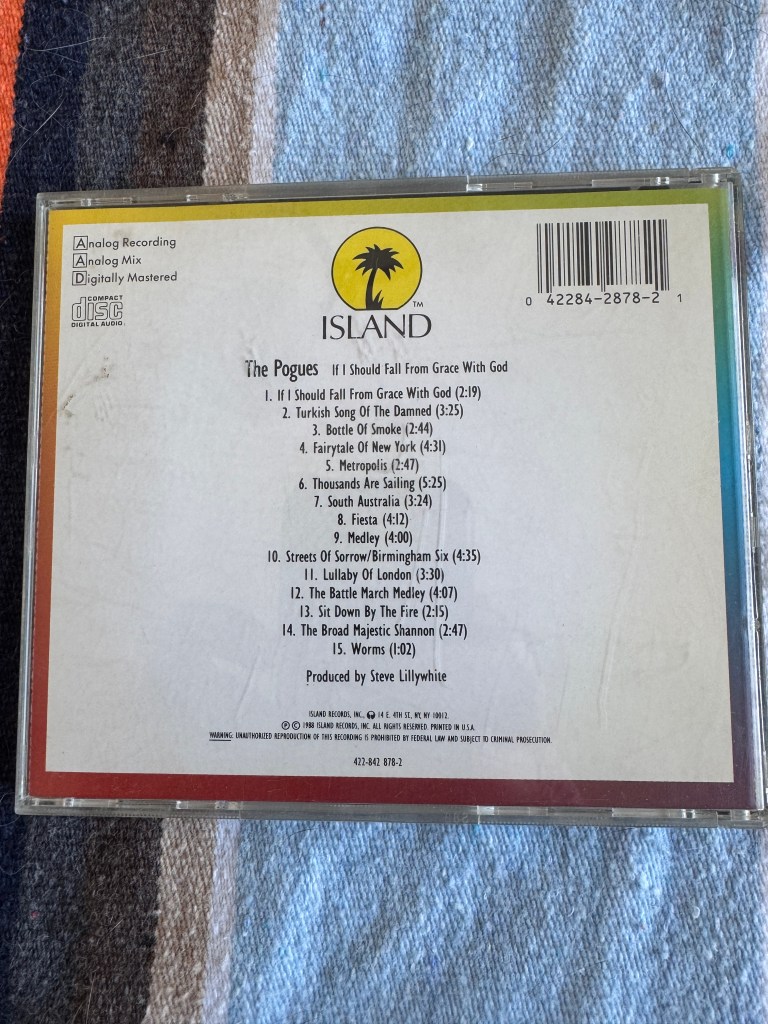
I waited until after the holidays to gather my thoughts about everyone’s favorite Irish Christmas song, the Pogues’ “Fairy Tale of New York,” because I’m cool like that. Far be it from me to spoil anyone’s well-intentioned enjoyment of an annual classic. And don’t worry, I won’t spoil it now, because I’ve made peace with it.
*Record scratch*
Let me back up. I first heard “Fairy Tale of New York” not long after it appeared on the band’s 1988 LP, If I Should Fall From Grace With God, and I thought it was fantastic. Incredibly catchy tune, vivid imagery, brilliant lyrics. It is an objectively great song.
Even at the time, though, I was a little shocked by their casual use of a certain homophobic slur — if you’ve heard the song, you know what I’m talking about.
To be fair, while that word jumped out at me, another questionable term in the same verse — slut — slipped right past me without a reaction. So, yes, it was a bit hypocritical of me to react negatively to one slur and not the other.
Still, I’ve spent a lot of time in recent years working with and fundraising for Lambda Legal, an organization that fights for LGBTQ+ rights, so hearing that verse so often during the holidays often feels like a gut punch.
In the Pogues’ defense, they do not try to sugar coat the language of the song, nor do they try, as many Americans do, to claim the word isn’t really a homophobic slur but just a general insult. Instead, as this December 23, 2025 Vice article explains, they acknowledge that the word means what it means, and I appreciate their honesty. Shane MacGowan put it this way:
“The word was used by the character because it fitted with the way she would speak and with her character,” MacGowan said in a 2018 statement, per NME. “She is not supposed to be a nice person, or even a wholesome person. She is a woman of a certain generation at a certain time in history, and she is down on her luck and desperate.”
Fair enough. I read an awful lot of Faulkner and Twain back in high school and college, and this was the common explanation for their repeated use of the n-word: that’s how these characters would have spoken in that time period, so don’t judge the author negatively for writing accurate dialogue. And, for what it’s worth, I never thought Shane or any of the Pogues were homophobic. It’s just that sometimes people who are part of a dominant group don’t perceive how their language affects people in marginalized groups, however unintentional that might be.
And — using the Faulkner/Twain analogy — I think a lot of white southern writers today might be a bit hesitant to drop the n-word so liberally in their works, even in the context of historical dialogue. So maybe it’s good that times change?
But I get the point. The Pogues aren’t saying that it’s okay to call people slurs, they’re writing dialogue that fits the characters in the song. Still, as the Pogues’ Jem Finer explained:
“If those lines were delivered in a play, it would be different, but a song puts words into people’s mouths to drunkenly sing, and they might not even realize what they’re singing, but suddenly it’s in the tube station.”
I guess that’s why I struggled with “Fairy Tale of New York” for so long. Finer’s point reminds me of white kids who love hip hop in no small part because it gives them license to recite n-word-laden verses out loud. Black rappers can use that term for obvious reasons (do I really have to explain this??), but, no, it’s not cool for white teenagers to sing it at the top of their lungs.
Frankly, I worry that some straight Pogues fans might get the same thrill out of, as Finer says, drunkenly singing “Fairy Tale of New York” loudly in public spaces because they think it gives them license to freely drop the f-bomb. (Not that f-bomb, the other f-bomb.) That’s not cool, man.
As I say, though, I’ve made peace with it. I understand why they used the term and the context in which they used it. Artists, especially rock ’n rollers, aren’t and never will be perfect, and if we hold them to a standard of perfection we’ll never be satisfied. Sometimes, you have to let these things go, so I’m letting this go.
One last thing. When I say I’m letting this go, I’m speaking only for myself. Language and art affect everyone differently, so everyone has to make up their own mind about what they can and can’t tolerate, whether it’s in a song’s lyrics or in any other context. I don’t expect everyone to agree with me on either point — that the song is problematic in the first place, or that I choose to let it go — because I don’t think there’s one right answer. That’s how art works. Everyone has to think for themselves.
But I promise not to drunkenly sing “Fairy Tale of New York” in a tube station. For a whole lot of reasons.
 Elvis Ate Dynamite
Leave a comment